🎤🔍 Eurovision 2026 Post-Mortem: How Bulgaria Beat Every Signal — And What the Data Actually Got Right
- Alessia Paccagnini
- 17 mag
- Tempo di lettura: 7 min

I told you on Friday night that “if consensus wins, Finland wins. If Eurovision wants its 2026 surprise, it lives at slot #8 (Australia), slot #10 (Malta), or slot #22 (Italy).”
Eurovision wanted its surprise. And it lived at slot #12: Bulgaria’s Dara, with “Bangaranga”.
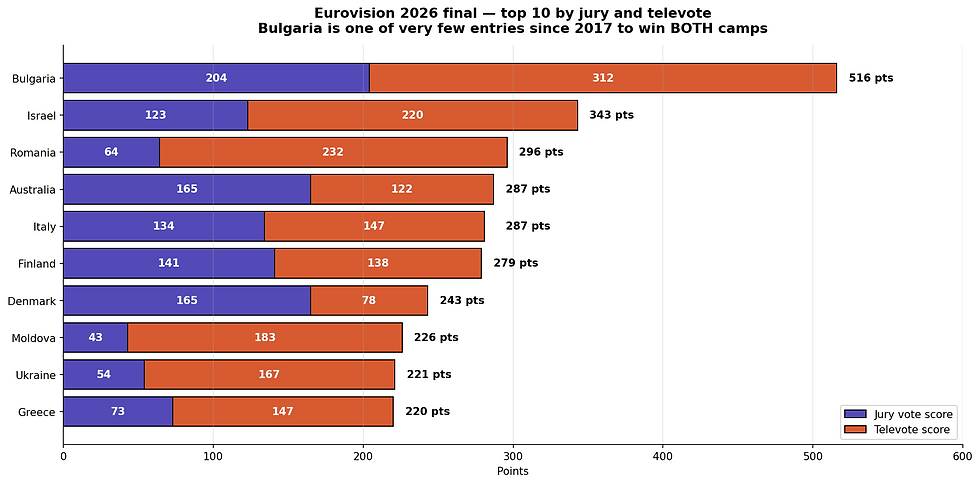
Bulgaria didn’t just win — it demolished the field with 516 points, a record-breaking 173-point margin (beating Alexander Rybak’s 169 in 2009). It won both the jury (204) and the televote (312) — the first time juries and the public have picked the same winner since Portugal 2017. It’s Bulgaria’s first-ever Eurovision victory after 19 attempts.
And every single one of my four pre-show signals had it wrong. So today, let’s do something I think is more interesting than gloating about a “correct” prediction: a real post-mortem with the full jury×televote voting matrices in hand. What did the data get wrong, what did it get right, and what does Bulgaria’s win actually tell us about Eurovision?
———
🎯 The prediction failure, in one chart
The bookmakers ranked Bulgaria #15 of 25 finalists, giving it a 1% chance of winning. The actual finishing position: #1.
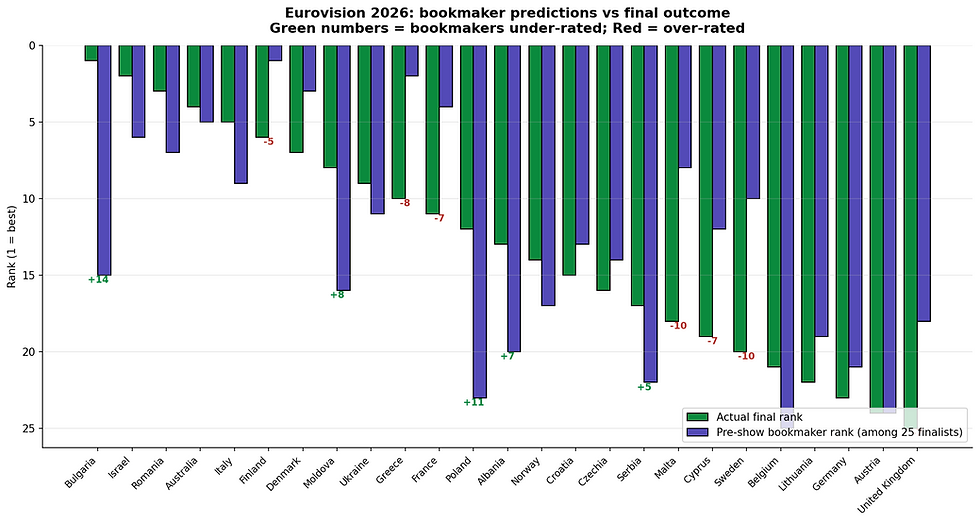
🧠 Insight: The bookmaker market was right about a lot — overall Spearman correlation with the final rank was ρ = +0.61 (p = 0.001), which is genuinely solid. But it was spectacularly wrong about the two most important questions of the night: who would win, and who would crash. Finland (the +44.6% favourite) finished 6th with 138 points. Bulgaria (the 1% outsider) jumped +14 places. Moldova jumped +8, Poland +11. The most underrated entries were all from the Eastern half of Europe — a regional bias the betting market hadn’t priced.
📊 Which pre-show signal actually predicted the final?
Across the 25 finalists, the four signals I tracked correlate with the final rank as follows:
• 🎰 Bookmaker rank vs final rank: ρ = +0.61 (p = 0.001)
• 🎫 OGAE fan rank vs final rank: ρ = +0.43 (p = 0.032)
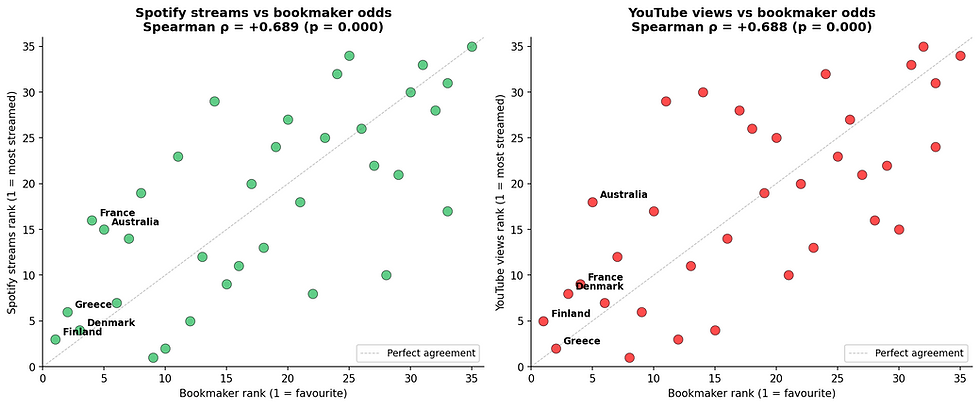
• 📺 YouTube rank vs final rank: ρ = +0.39 (p = 0.055)
• 🎧 Spotify rank vs final rank: ρ = +0.34 (p = 0.100)
Bookmakers were the best aggregate signal — they price in everything — but no signal got Bulgaria right. The two that got closest were YouTube (Bulgaria #4 with 4.0M views) and the semi-final 2 televote (Bulgaria won SF2 with 184 televote points — the biggest of any country in any semi-final this year). Both signalled days in advance that something was happening with Bangaranga that the consensus wasn’t pricing in.
🧠 Insight: When all signals agree, the consensus is usually right. But when one signal (YouTube) and one stage result (SF2 televote) disagree dramatically with the others, those are the moments to pay attention. Bulgaria’s case is the textbook example.
🤝 Bloc voting? The data demolishes the theory
Given Bangaranga was co-written by Greek composer Dimitris Kontopoulos and features Greek vocalist Victoria Chalkiti, my first question was: was this a Greek-Balkan voting bloc producing a winner?
The data emphatically says no. Bulgaria got points from 30 of 35 national juries AND 35 of 36 televoters (every single televoter in the world except Bulgaria itself, which can’t vote for itself). That’s the broadest support base in years.
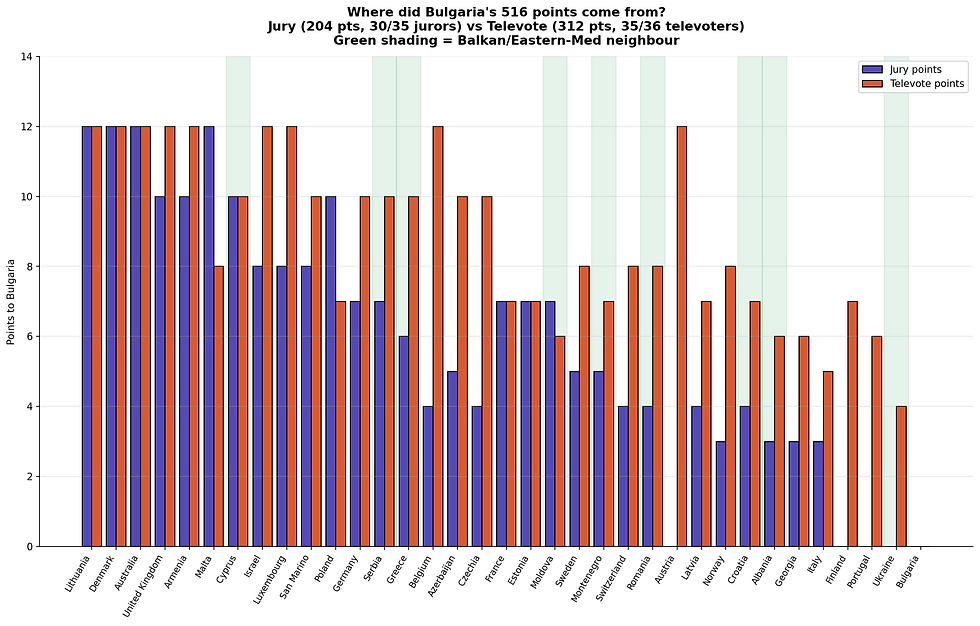
Quantitatively: only 22.5% of Bulgaria’s jury points and 21.8% of its televote points came from its nine Balkan/Eastern-Mediterranean neighbours combined. 78%-plus of Bulgaria’s support came from outside the bloc.
🧠 Insight: Eurovision winners that “win on bloc voting” usually have concentrated support — a few jurors give 10s and 12s, lots give zero. Bulgaria’s pattern is the opposite: broad-spectrum 6s, 7s and 8s from almost everywhere, plus 14 separate 12-point maxima. That’s not bloc voting; that’s broad cross-cultural appeal. The Greek production credit may have helped craft a song that travelled well, but it didn’t manufacture a regional voting bloc.
🌟 Fourteen 12s from a single song
Bulgaria collected an extraordinary 14 sets of 12 points in total across both camps — 4 from juries (Malta, Denmark, Australia, Lithuania) and 10 from televoters (Luxembourg, Israel, Belgium, Australia, Lithuania, UK, Armenia, Austria, Denmark, and the Rest of the World online vote).
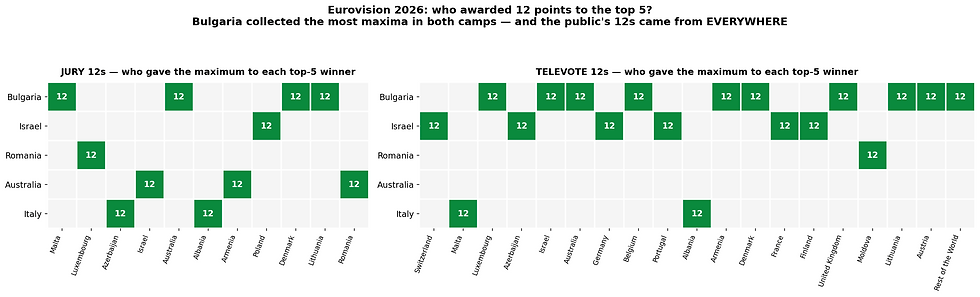
Compare to the rest of the top 5: Israel got 1 jury 12 (from Poland) and 6 televote 12s. Romania, despite finishing 3rd, collected just 1 jury 12 (Luxembourg) and 1 televote 12 (Moldova) — a totally different shape of victory. Australia, 4th, got 3 jury 12s but zero televote 12s. Italy got 2 jury + 2 tele 12s.
🧠 Insight: Two things stand out in this heatmap. (1) Australia gave Bulgaria a double 12 — both jury and televote — which is the strongest endorsement any voter can give. (2) Israel’s televote 12 went to Bulgaria, while their jury 12 went to Australia. This jury-vs-public split inside Israel mirrors the broader pattern we’ll see below: juries and publics consistently disagreed on what the best song of the night was.
📡 Juries vs the public — where each country split
With both matrices in hand, we can compute, for each voter country, the Spearman correlation between its own jury’s rankings and its own public’s rankings. Where juries and the public agreed, ρ is positive. Where they ranked the songs in opposite orders, ρ is negative.
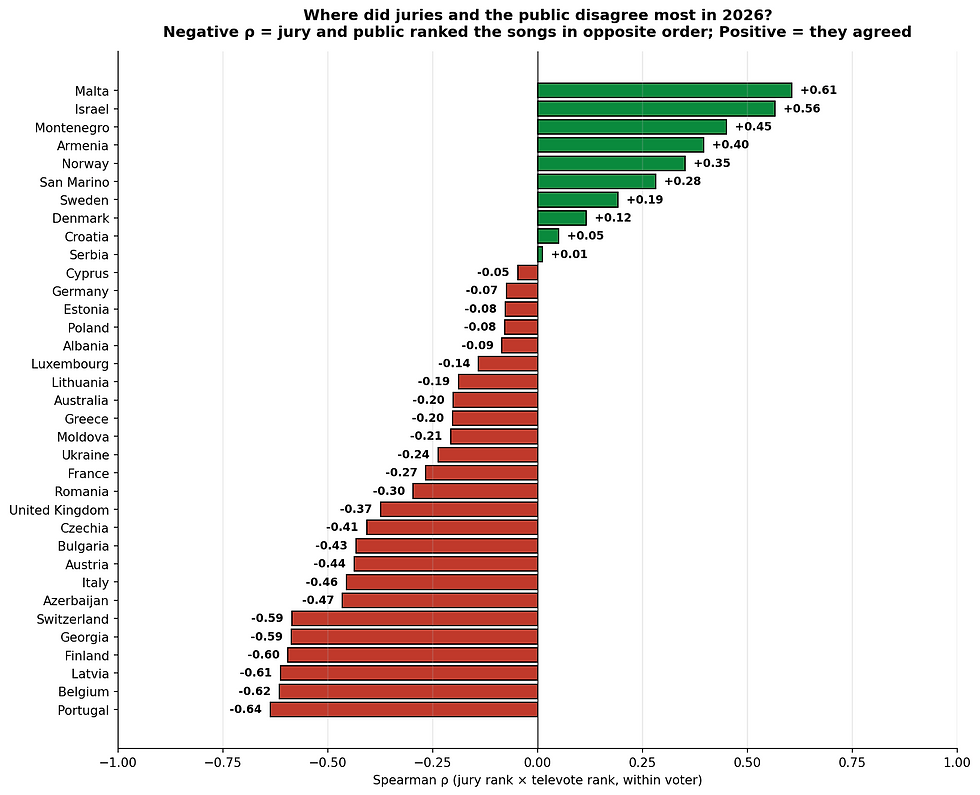
The result is striking: most countries’ juries and publics disagreed, often strongly. The most divergent voters were Portugal (ρ = −0.64), Belgium (−0.62), Latvia (−0.61), Finland (−0.60), Georgia (−0.59) and Switzerland (−0.59). In these countries, the jury essentially picked the opposite songs to the public.
The most aligned voters were Malta (+0.61), Israel (+0.56), Montenegro (+0.45), Armenia (+0.40), Norway (+0.35) — countries where experts and viewers had genuinely similar taste.
🧠 Insight: This is the structural story of modern Eurovision in one chart. The 50/50 jury/televote system has become a contest of two electorates with diverging tastes. That’s why Bulgaria’s win is so historically unusual: Bangaranga is the rare song that bridged the gap. Watch this become the new template producers chase for 2027.
🌍 Romania vs Bulgaria: same region, opposite voting profiles
The single most striking number from the final scoreboard: Romania got 232 televote points but only 64 jury points— a televote phenomenon, exactly the dance-pop “fun song” model. Romania got jury points from only 16/35 jurors but won the public over for 3rd place.
Bulgaria did the opposite: broad-spectrum jury appeal (30/35 jurors, 204 points) plus the highest televote (312, way ahead of Romania’s 232). The two Balkan returners produced two completely different voting patterns. One won on jury breadth, the other on televote intensity — and Bulgaria’s combination of both was unbeatable.
🕸️ What did the network analysis say — and was it right?
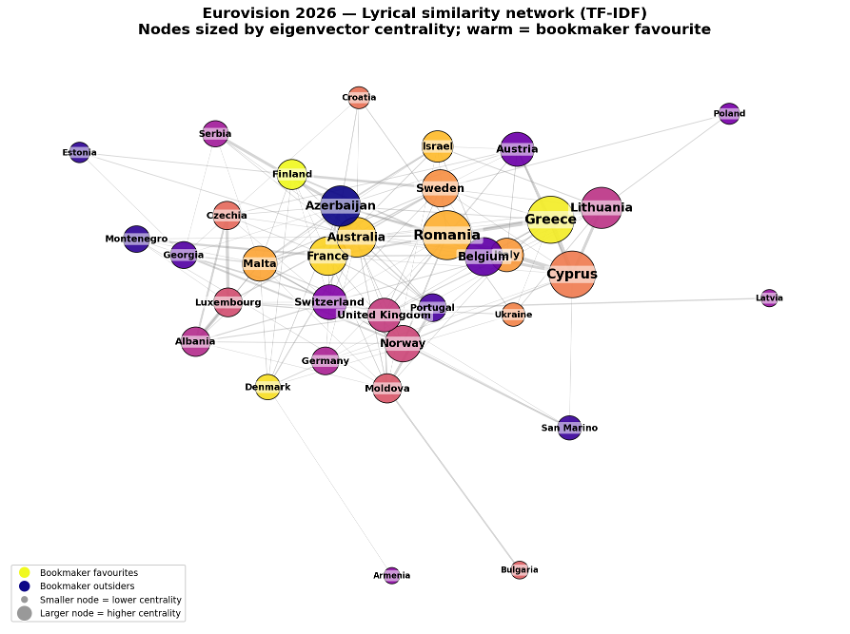
Last week’s network piece flagged that the previous two winners (Nemo 2024 and JJ 2025) were both peripheral on lyrical similarity networks — the songs that stood out won. Bulgaria’s Bangaranga was also peripheral on both our networks (TF-IDF and LDA). So the network finding did hold — winners stand out, not blend in.
What the network couldn’t capture: that Bulgaria’s “standing out” was via production polish (multi-national co-writers, including hitmaker Kontopoulos) and staging energy, not via thematic content. That’s a structural limit of any text-only model — and a useful corrective for next year’s work.
🎭 What I got right, what I got wrong
Honestly:
• ✅ The network “periphery wins” pattern held (Nemo → JJ → Dara — three winners in a row).
• ✅ The Måneskin precedent was the right thesis — bookmaker consensus was missing a televote phenomenon. The pattern was right. The country was wrong (Italy finished 5th, not 1st). Bulgaria was the actual Måneskin of 2026.
• ✅ I flagged that the “surprises live where signals disagree” — and Bulgaria was where YouTube and the SF2 televote disagreed most loudly with bookmakers.
• ❌ I never elevated Bulgaria above “wildcard” status — and I should have, given it was #4 on YouTube and won SF2 televote by a massive margin.
• ❌ All four signals failed to flag Romania’s televote ceiling — that’s a model gap to address next year.
🔬 What this means for the academic project
For the network-analysis:
• We can compare the pre-show centrality structure with the post-show voting flow — does lyrical periphery translate into a particular kind of voting pattern (broad jury support? high televote? both)? Bulgaria suggests “both, when the song is dance-pop with international production”. Worth formalising.
• We can study the breadth-vs-depth trade-off in jury support empirically — Bulgaria (30 jurors), Australia (25), Italy (23), Romania (16), Ukraine (9) are five clean profiles producing the top 10.
• The jury-televote divergence index by voter country is, by itself, an interesting research object: which juries’ tastes are most “popular”? Which are most “elite”? Malta and Israel sit at one extreme; Portugal, Belgium and Latvia at the other. Worth a paper.
• The reciprocal Bulgaria↔Malta jury 12 exchange (and Bulgaria’s tele 12 going to Greece, while Israel’s tele 12 came back to Bulgaria) gives us specific named edges to investigate in the 2026 voting graph.
That’s four real research questions out of one weird night.
———
🧠 Final insight: Bulgaria’s win is not a story about bookmakers being incompetent. It’s a story about what bookmaker markets can’t price — staging on the night, broad jury aesthetics, and the way a single up-tempo song with the right production team can sneak past four independent forecasting channels at once. The post-mortem lesson isn’t “burn the odds”. It’s “watch the disagreements between signals”, and treat SF2 televote totals + YouTube rank + bookmaker pricing all pulling in different directions as a tradeable signal next year.
So — the data didn’t win, and the magic didn’t quite win either. What won was the rarest thing in Eurovision: a song that, across thirty-five different televoting publics and thirty-five different professional juries, genuinely landed almost everywhere it was heard.
Congratulazioni Bulgaria. 🇧🇬💛 Bangaranga in Sofia 2027 for the new party!
———
If you enjoyed this piece, you might also like the full Eurovision 2026 series:
Data sources: official Eurovision 2026 jury voting matrix (25 contestants × 35 national juries) and televote matrix (25 contestants × 36 voters, including the Rest of the World online vote); pre-show signals (bookmaker odds, OGAE, Eurojury, Spotify, YouTube) from the panel built in the previous pieces. Replication code available on request.

Commenti