🕸️ Eurovision 2026 as a Network: Who's Mainstream, Who's Alone
- Alessia Paccagnini
- 10 mag
- Tempo di lettura: 4 min

After the lyrics analysis and the fun stats post, I wanted to try one more angle on Eurovision 2026 before Saturday's Grand Final.
This time: a network.
In the academic work I've been doing with my co-authors Alessia Morrone, Barbara Będowska-Sójka, Sabrina Giordano, and Claudia Tarantola, we use network analysis to study how countries vote for each other in Eurovision — who has voting alliances, who's culturally close, who sits on the periphery. That work is at the country level.
For this post, I asked a different question: what if we built a network of the songs themselves? Two songs are connected if their lyrics are similar.The result is a kind of "lyrical map" of Eurovision 2026 — and centrality measures can tell us which songs are most representative of the contest, which are unique outliers, and whether the bookmaker favourites cluster together at all.
I built three networks. Each tells a slightly different story 👇
🎤 Network 1: Lyrical similarity (TF-IDF)
The first network connects songs that share vocabulary. Using TF-IDF (term frequency–inverse document frequency, the same family of methods that powers search engines), I computed how lexically similar each pair of 2026 songs is, then drew an edge whenever similarity was above the 75th percentile.
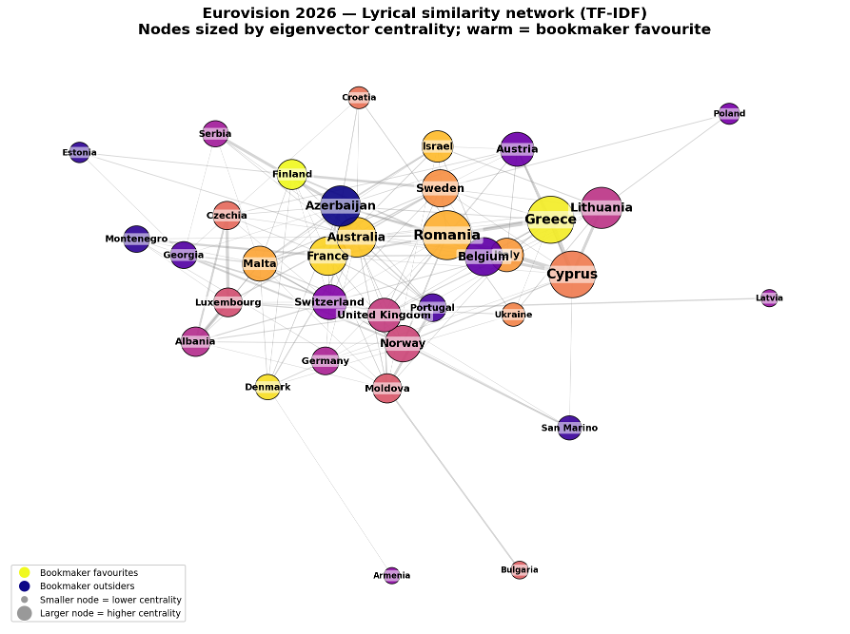
🧠 Insight: Romania's Choke Me is the most lyrically central song of 2026 — by eigenvector centrality, it shares vocabulary with more songs than any other entry. Greece (Ferto) and Cyprus (Jalla) are also highly central. The three are forming the "lyrical mainstream" of the contest, even though only Greece is among the top favourites.
The outliers are striking too: Armenia (Paloma Rumba), Latvia (Ēnā), Bulgaria (Bangaranga) and Estonia (Too Epic To Be True) sit at the network's edges. Their vocabulary doesn't overlap much with anyone else's. Linguistically, they're alone.
And Finland, the bookmaker favourite? Mid-network. Connected, but not at the centre.
🎭 Network 2: Thematic similarity (LDA topics)
Lyrical similarity captures shared words. But two songs can be about the same thing while using different words — "ocean" and "sea", "dance" and "move", "love" and "passion". So I built a second network using Latent Dirichlet Allocation (LDA), a topic-modelling method that finds latent themes across the corpus and then measures how similar two songs are in their topic mix.
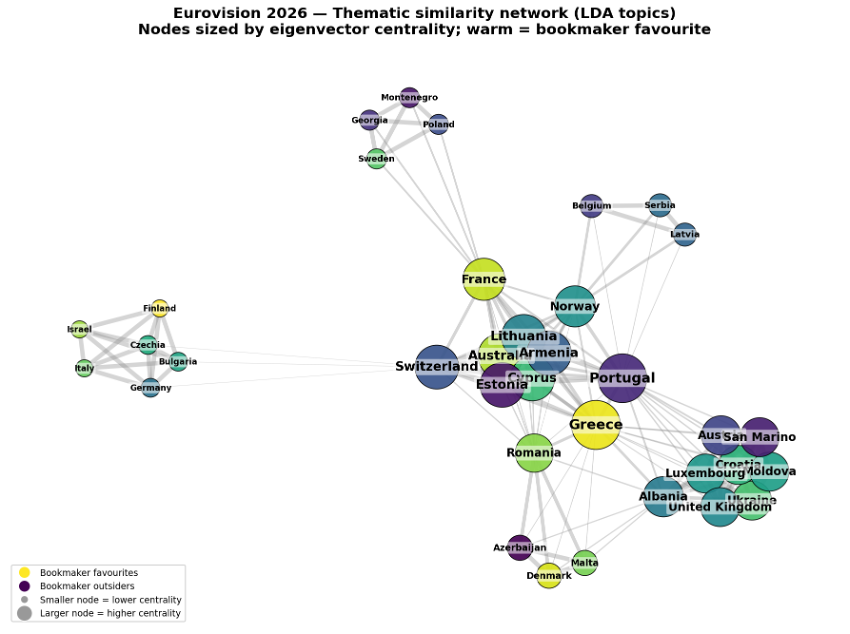
🧠 Insight: This network has a clear structure that the TF-IDF version doesn't — two distinct sub-communities plus a connecting bridge. The largest cluster, in the centre-right, is the thematic mainstream: Cyprus, Estonia, Switzerland, Lithuania, Armenia, Australia, Portugal — all sharing a similar topic distribution. A second smaller cluster on the left contains Finland, Israel, Italy, Czechia, Bulgaria, and Germany — six songs grouped by a love-and-night topic mix that the rest of the contest doesn't share.
That's a remarkable finding for a favourite. Finland isn't just outside the lyrical mainstream — it's in a distinct thematic minority. If thematic centrality predicted winning, Finland would be in trouble. Whether it does predict winning is the question we'll answer on Saturday.
🌐 Network 3: Theme co-occurrence
The third network steps back from individual songs. Instead, the nodes are themes (love, body/dance, darkness, spiritual, war/peace, materialism, home/identity, joy/party), and edges measure how often two themes appear together in the same song.
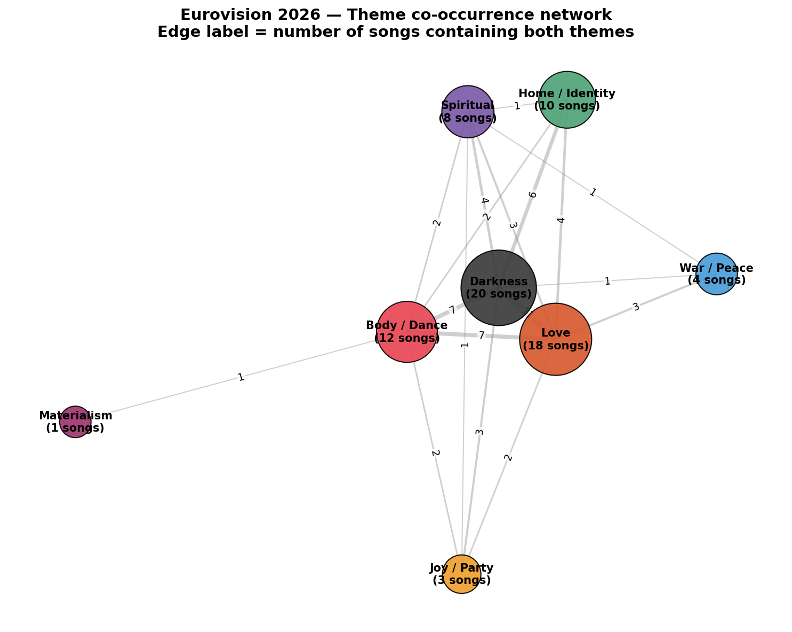
🧠 Insight: Eurovision 2026's emotional landscape is dominated by two themes: darkness (present in 20 of 35 songs) and love (18 of 35), with a thick edge of 7 songs where they co-occur. Body/dance is the third gravitational centre, also pairing strongly with love (7 co-occurring songs).
Materialism is structurally alone — only Greece's Ferto triggered the materialism theme, and it connects only weakly to body/dance. That makes Greece both the most thematically distinctive song of the year and the bookmaker's #2 pick. Sometimes being different works.
🔍 What does "centrality" actually mean here?
I want to be honest about what these numbers do and don't tell us.
Eigenvector centrality measures how connected a song is to other well-connected songs. A song with high centrality is "in the middle" of the lyrical conversation; low centrality means "alone on the edge."
What centrality is not: a measure of quality, originality, or memorability. The most-central song isn't necessarily the best, just the most typical. Some of Eurovision's most iconic winners were peripheral on lyrical metrics — Måneskin's Zitti e buoni (2021) and Salvador Sobral's Amar pelos dois (2017) would both score low on lyrical centrality if we ran the same analysis on those years.
So when Romania, Greece, and Cyprus emerge as central in 2026, that doesn't mean they'll win. It means they're the lyrical median of the contest — and deviation from that median is part of what makes a song memorable.
🎬 Will the favourite win?
By Saturday we'll know. Until then, here's what the data leaves us with:
The bookmaker favourite (Finland) is in a lyrical and thematic minority — central by neither metric.
The most central songs by lyrics (Romania, Greece, Cyprus) are not the favourites — Greece is #2, but Romania is #7 and Cyprus #12.
The most distinctive songs (Greece on materialism, Poland on prayer, Norway on conflict) all chose to be different.
Eurovision 2026 has both a centre and a periphery. Saturday tells us which one Europe rewards.
Stay tuned — and may the most-connected song win 🕸️ (or maybe the most disconnected one wins, that's the whole point 😉).
If you enjoyed this, you might also like:

Commenti