🎉 Eurovision 2026: 12 Surprising Numbers from the 70th Edition
- Alessia Paccagnini
- 10 mag
- Tempo di lettura: 4 min

So Eurovision 2026 is upon us — the 70th edition, hosted by Vienna for the third time in the contest's history (after 1967 and 2015). After last week's post on what the 2026 lyrics tell us, I went back into the data with a different question: what are the strangest, most surprising numbers behind this year's contest?
Some come from the lyrics dataset I built with Alessia Morrone, Barbara Będowska-Sójka, Sabrina Giordano, and Claudia Tarantola. Others come from the bookmakers, the OGAE fan poll, the Eurojury, and Eurovision history itself.
Twelve fun facts, in no particular order — perfect for impressing someone at a Eurovision watch party 🍷.

1️⃣ Five countries pulled out — the biggest boycott since 1970
Iceland, Ireland, the Netherlands, Slovenia, and Spain all withdrew from this year's contest in protest of Israel's continued participation. That's the largest number of boycotting countries since 1970, when several nations boycotted the Madrid contest. With 35 countries competing, this is also the smallest field since semi-finals were introduced in 2004.
2️⃣ Three countries came back
Balancing the withdrawals, Bulgaria, Moldova, and Romania all return to Eurovision after recent absences. The net effect is an unusually large reshuffle of who's in and who's out — the biggest single-year change in participation since 2008.
3️⃣ Only 14% of songs are sung in English
That's a striking finding. Just 5 of the 35 entries are in English — a low share by historical standards. The rest sing in Albanian (5 entries — the most of any non-English language!), Russian, Croatian, Ukrainian, Finnish, French, Italian, German, Estonian, Turkish, and many more. Eurovision 2026 is genuinely multilingual.
4️⃣ "Want" beat "Love" for the first time in 11 years
This was the headline of last week's post, but the number bears repeating: across all 35 songs, "want" appears 81 times; "love" 69 times. Every previous year from 2015 to 2025 had "love" at #1.
5️⃣ But 24 out of 35 songs still mention love at least once
Even with "want" leading, 69% of all 2026 entries contain at least one love-word (love, heart, kiss, baby, darling, romance…). The 11 songs with zero love words include this year's #2 favourite Greece (Ferto — about money, not love), Germany (Fire), Estonia (Too Epic To Be True), and Austria (Tanzschein).
6️⃣ The most positive song of 2026? Malta. The most negative? Germany.
Running VADER sentiment analysis across all 35 entries:
Most positive: Malta — Aidan, Bella (compound score +0.999)
Most negative: Germany — Sarah Engels, Fire (compound score −0.999)
A perfect mirror image. Six-tenths of a thousandth apart from the theoretical extremes.
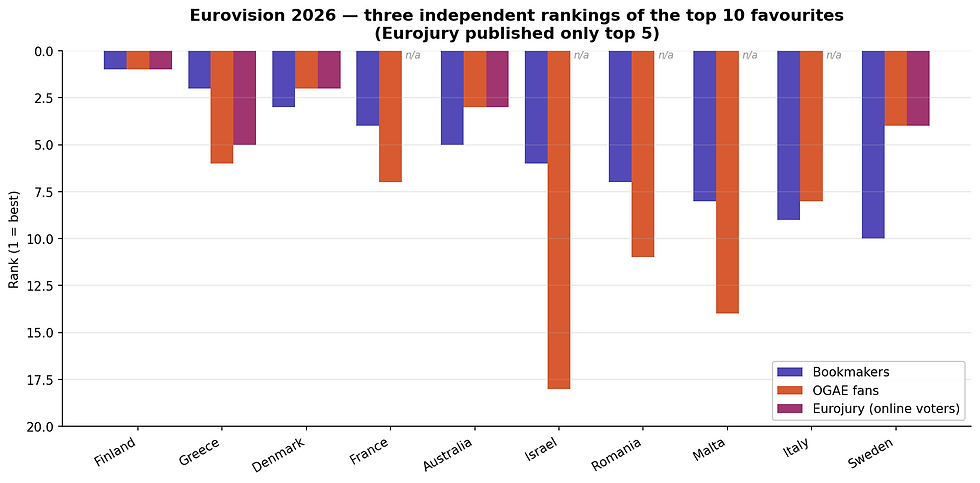
7️⃣ Bookmakers, fans, and Eurojury all picked Finland #1
Three independent ranking systems — bookmakers (markets), OGAE (43 fan clubs, 3,846 voters), and Eurojury (online voting panels) — all chose Finland's "Liekinheitin" as their top pick. That kind of three-way agreement is rare; usually at least one of them dissents.
8️⃣ But sentiment doesn't predict success
Here's a fun statistical finding: when I correlate VADER sentiment scores with bookmaker rank, the Spearman ρ is just +0.08 (p = 0.65) — essentially zero. Bookmakers are not rewarding positive lyrics. They might be rewarding vocals, staging, or hooks — but not feelings.
9️⃣ The most repetitive song? Denmark.
By lexical diversity (unique words ÷ total words), the most repetitive song is Denmark — Søren Torpegaard Lund, "Før vi går hjem" ("Before we go home"). It uses only 23% unique vocabulary across 231 words. The chorus does a lot of heavy lifting.
The most varied vocabulary is Serbia — Lavina, "Kraj mene", with 88% unique words — almost no repetition at all.
🔟 Greece wrote the only "rich-and-flexing" song of 2026
Theme analysis flagged Greece's Ferto as the only song where materialism dominates the lyrics — crowns, thrones, diamonds, designer shades, yacht with stars, Cuban links, "submarines, jet machines". Other countries have one or two such words; Greece built an entire song around it. Even more impressively, Greece is currently #2 with the bookmakers, suggesting flex anthems can work.
1️⃣1️⃣ Poland's "Pray" is the most prayer-dense song in the contest
15.6% of all meaningful tokens in Poland's Pray are spiritual words — God, prayer, soul, faith. It's also the only entry where the spiritual theme dominates over love, body, and party themes combined.
1️⃣2️⃣ This is Vienna's third Eurovision — earned the same way each time
Each of Vienna's three hostings followed an Austrian victory: Udo Jürgens in 1966 → 1967 contest. Conchita Wurst in 2014 → 2015 contest. JJ in 2025 → 2026 contest. That's a 60-year tradition, and the Wiener Stadthalle (the same venue as 2015) has now hosted Eurovision twice.
🎤 Bonus number: 70
The official 2026 logo is a "Chameleon Heart" composed of 70 layers of the Eurovision heart in 3D, one for each edition. The interval acts at the Grand Final include past champions Lordi (Finland 2006), Alexander Rybak (Norway 2009), Verka Serduchka (Ukraine 2007), and Kristian Kostov (Bulgaria 2017) — a deliberate love letter to the contest's seven-decade history.
So whether you're watching for the music, the politics, the fashion, or the data 📊 — Eurovision 2026 has something for everyone.
If you enjoyed this, you might also like:

Commenti